Pool Fence Guide: Safety, Regulations, and Options
Why Pool Fencing Matters: Safety Fundamentals and Real-World Risk
A pool is equal parts joy and responsibility. The water invites cannonballs and lazy afternoons, but it also demands a careful plan to keep curious kids, visiting relatives, neighbors, and pets out when no one is watching. That plan starts with a barrier. Multiple studies from public health authorities have linked four-sided isolation fencing to substantially lower drowning risk for young children compared with three-sided “property line” barriers that rely on the house as one side. Exact figures vary by study and setting, but reductions on the order of several dozen percentage points are consistently reported. In everyday language: a properly designed, compliant fence buys you time, and time is everything when seconds matter.
How does a fence reduce risk? It disrupts the most common scenario—an energetic child slipping away from sight for just a moment and reaching the water. A pool fence is a door that’s hard to open, a climb that’s hard to complete, and a path that’s easy for an adult to monitor. When paired with self-closing, self-latching gates and clear sightlines, it becomes a predictable, passive safety layer. That matters because human attention is limited; the barrier keeps working even when you are pouring lemonade, answering the door, or chatting with guests.
Safety also depends on thinking in layers. Consider this practical hierarchy of protection: - Active supervision: attentive, within arm’s reach for young swimmers. - Passive barriers: code-compliant fences, self-closing gates, door alarms to the yard. - Skills and preparation: swim lessons, rescue knowledge, and CPR training. - Environmental cues: clear water, visible bottom, and uncluttered decks to spot trouble quickly. Each layer covers the others when real life intrudes. A fence will not replace the need to watch children, but it reduces the chance that a brief lapse becomes a tragedy.
It is also wise to plan for non-child scenarios. Guests unfamiliar with your yard layout may step outside at night. Pets can wriggle through surprisingly small gaps. Wind can slam an unlatched gate. A well-designed fence anticipates these mundane failures, with swing direction that favors safety, latches that resist casual tugs, and gaps and heights tuned to prevent squeezing through or climbing over. Think of it as the seatbelt for your backyard oasis: unobtrusive, always on, and quietly essential.
Regulations and Codes: Understanding Requirements and Navigating Permits
Pool barrier rules are local, and that means specifics change from place to place. Still, common threads appear in many residential codes and municipal ordinances. Typical minimum fence height falls between 48 and 60 inches (about 1.2–1.5 m). Maximum space under the bottom rail is often limited to roughly 2 inches to prevent crawling. Vertical picket spacing is commonly capped near 4 inches to block head-and-shoulders passage. Mesh and chain-style barriers may be required to have small openings, frequently around 2 to 2.25 inches, to deter footholds. Gates are usually self-closing, self-latching, and swing outward, away from the pool area. Latch releases are commonly placed high—often around 54 inches or more from grade—so young children cannot reach them easily.
Beyond dimensions, many codes address climb resistance. Horizontal members on picket fences are often required to be spaced so they can’t form a ladder, or positioned on the pool side where they are harder to use as steps. Solid walls and glass panels may need to be smooth and free of projections. If the house forms one side of the barrier, doors and windows that open to the pool area commonly must be protected by alarms, self-closing devices, or both. Some jurisdictions also specify setback distances from property lines and utilities, as well as requirements near slopes, retaining walls, and waterfronts.
The permit path is straightforward if you know what to bring. Plan on: - A site or plot plan showing pool location, fence layout, and gate swing direction. - Product specifications: panel heights, post spacing, latch model type, and opening sizes. - Footing details: post embedment depth, concrete size, and drainage notes. - Notes for grade changes, steps, and transitions to existing structures or hedges. An inspector will check that design intent matches code language before work starts, and then confirm the installation meets the approved plan at final inspection.
Because language varies, treat published numbers as benchmarks rather than guarantees. Your town or region might have stricter rules for waterfront lots, historic districts, or multi-family properties. Some places require anti-entrapment clauses for pets; others define “climbable” in ways that affect decorative trim. Before you purchase materials, call your building department, ask for the current pool barrier handout, and verify whether a survey or homeowner association approval is needed. A half-hour of paperwork preparation can save days of rework in the yard.
Fence Materials and Design Options: Pros, Cons, Durability, and Cost
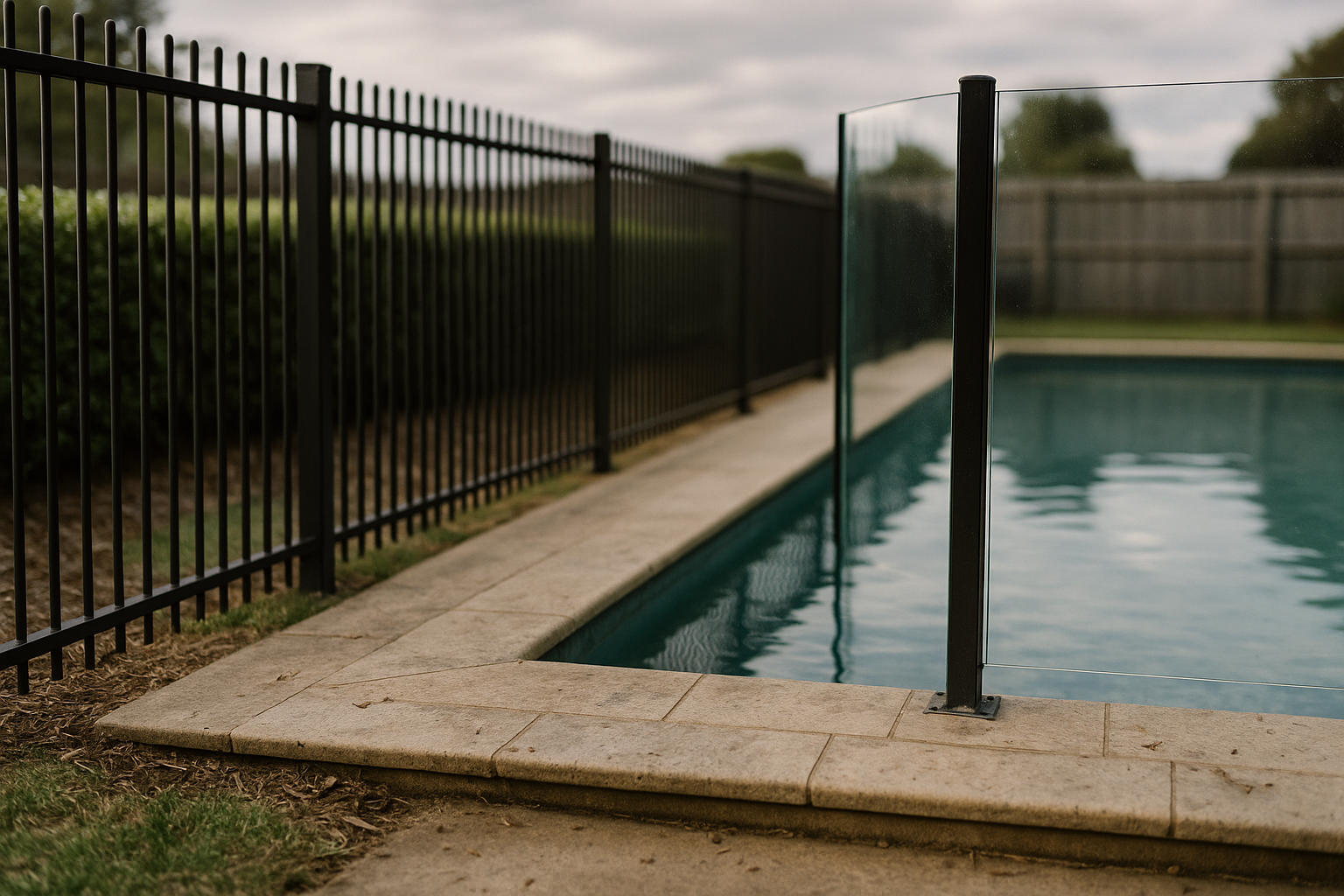
Choosing the right material is a balance between safety, style, visibility, maintenance, and budget. Aluminum picket systems (often powder-coated) are popular because they are corrosion-resistant, light, and relatively easy to install. They provide good visibility into the pool while meeting typical spacing rules. Steel variants add rigidity and weight but may demand more upkeep in coastal or deicing-salt environments. Glass panels offer uninterrupted views and a clean, modern line; tempered glass is strong, and properly supported panels can handle wind and the bumps of daily life. Mesh/removable systems appeal to families who want flexibility; they can be taken down for parties and reattached quickly, though long-term durability depends on fabric quality, post anchoring, and UV exposure.
Wood remains a classic, with privacy potential and warm aesthetics. Hardwoods and well-sealed softwoods can perform admirably when maintained, but wood demands consistent attention to finish and fasteners. Vinyl or composite systems are low-maintenance and provide robust privacy, though they can be bulkier and may catch more wind, requiring sturdier posts and footings. Masonry—block or brick walls—delivers durability and privacy but requires careful design for gates, sightlines, and code-compliant heights and surfaces. Natural hedges look lovely but rarely meet barrier requirements on their own; at most, they supplement a compliant fence, not replace it.
Budget planning benefits from realistic ranges: - Mesh/removable: often the most economical; ballpark per-linear-foot costs at the lower end, with quality hardware raising the total. - Aluminum picket: moderate cost with strong corrosion resistance. - Steel picket: moderate to higher cost; increased strength and weight, potentially higher maintenance. - Glass panels: higher cost due to tempered panels, precision hardware, and structural posts. - Wood: varies widely; materials can be affordable, but finishing and maintenance add ongoing expense. - Vinyl/composite: mid to higher initial cost, typically lower maintenance over time. Regional labor and footing requirements can shift these ranges meaningfully.
Durability considerations should guide design choices. In freeze-thaw climates, posts benefit from deeper footings below frost depth and well-drained concrete to avoid heave. Near saltwater or chlorinated splash zones, favor corrosion-resistant alloys and fasteners. For wind-prone sites, semi-open designs (picket or mesh) relieve pressure better than solid panels. For homes that treat the pool as a focal point, glass delivers remarkable visibility; for those prioritizing seclusion, wood, vinyl, or masonry provide a quiet backdrop that still meets barrier duties. Aim for a fence that does its job without drawing attention to itself—safe by design, graceful in company.
Gates, Latches, and Critical Dimensions: Small Details, Big Impact
Gates are where a barrier lives or fails. A code-compliant fence with a sticky hinge or low latch is an invitation to trouble. Most regulations require gates to be self-closing and self-latching, swinging away from the pool area. The closing force must be strong enough to overcome minor friction and wind, yet gentle enough to avoid slamming. Many homeowners choose magnetically assisted or gravity-driven latches because they are less sensitive to minor misalignment over time. Whatever the mechanism, a common rule of thumb places the release at or above about 54 inches, or requires it to be on the pool side behind a narrow opening so small hands cannot reach through.
Dimensional discipline matters around the gate as much as the panels. Keep the gap beneath the gate consistent with the rest of the fence, frequently near 2 inches or less. Avoid wide jamb spacing that could create a foothold or pinch point. If vertical pickets flank the latch area, maintain the typical sub-4-inch spacing. For solid gates—wood, vinyl, or glass—confirm that hardware fasteners penetrate adequately and that the gate is braced to prevent sag. On slopes, consider stepping the fence to keep the bottom clearance in range instead of raking a gate that will bind. A short, flat landing on both sides of the swing path improves safe entry and reduces trip hazards.
Reliability grows out of routine checks. A quick monthly ritual helps: - Let the gate swing from fully open; confirm it closes and latches automatically. - Test the release height and reach; ensure a child cannot trigger it through openings. - Inspect hinges for play and fasteners for corrosion or loosening. - Verify bottom and side clearances remain within your local limits. - Confirm sightlines: you should be able to see the water from the approach. This small habit finds problems while they are still easy to fix.
Don’t forget special use cases. Pets can press noses under low clearances or chew on softer components; plan materials and tolerances accordingly. Hot, dry climates can shrink wood; humid ones can cause swelling—both can misalign latches unless you allow for seasonal movement. Near the shallow end or steps, some owners prefer gates positioned to steer traffic toward safer entries with handholds. Good gate layout supports the way people actually move, keeping the barrier intuitive rather than obstructive.
Installation, Maintenance, and Budgeting: From Layout to Long-Term Care (Conclusion)
Great pool fences begin on paper. Sketch the yard, mark the water’s edge, doors, pathways, and utilities, and then trace a continuous barrier line that avoids steep slopes and awkward corners. Keep the fence far enough from the water to allow deck furniture and safe circulation, yet close enough to protect the perimeter without creating concealed nooks. Before digging, call for utility locates. In frost-prone regions, set posts below frost depth; in sandy soils, consider larger footings or sleeves for stability. If you’re weighing do-it-yourself against hiring a contractor, compare not just material prices but also tool rental, disposal, permit time, and the value of a clean, inspection-ready installation.
Project budgeting is smoother with a phased plan: - Design and permits: modest fees plus time for revisions if needed. - Materials: choose a system that matches local code and climate realities. - Labor: variable; complex slopes, walls, or glass raise the skill requirement. - Inspection and punch list: allocate time to correct small issues discovered late. When comparing quotes, look for detailed line items: post spacing, footing sizes, gate hardware type, and finish or coating specifics. Clarity at the contract stage prevents assumptions that can cost money later.
Maintenance keeps performance consistent. Once per season, wash panels and hardware to remove salt and chemical residue. For metals, check coatings for chips and touch up promptly to prevent corrosion. For wood, inspect finish integrity, look for raised grain or splits, and recoat to keep water out. Mesh fences deserve close attention to fabric tension, post sleeves, and latch stitching. Glass benefits from periodic cleaning and checks that rubber or polymer gaskets have not hardened or cracked. Keep vegetation trimmed away from the barrier; vines and shrubs not only add weight and moisture but can also create climbable surfaces.
As a closing thought, remember the goal: a fence that quietly supports the way your household lives. Choose materials that match your climate and maintenance appetite, dimensions that line up with local rules, and gate hardware that works the same way every single time. If you want airy views, glass or open pickets provide transparency; if you prefer privacy, wood, vinyl, or masonry can anchor a calm retreat. With a clear plan, honest budget, and steady upkeep, your pool fence becomes more than a code requirement. It becomes a reliable guardian that preserves the fun while safeguarding the people who matter most.